

ByJohn A
I Went Looking for the Safest Way to Buy Selank Online. I Found a Shutout.
I started this one assuming I’d find a spectrum. A little sketchy here, pretty solid there, the usual muddy middle you get when you go digging into any supplement corner of the internet. That is not what turned up.
What turned up was a scoreline. Four to zero. And once you see how the four gets earned and the zero gets earned, you stop expecting a middle ground to exist, because the market simply doesn’t have one.
Before any of that: Selank is not an FDA-approved drug in the United States. Keep that sentence taped to the fridge while you read the rest of this, because nothing below changes it.
The claim I was testing
The pitch you see repeated across forums and search results is that buying Selank online is basically a coin flip on quality, and if you’re careful, read reviews, check for a certificate of analysis, you can land on a decent vendor. I wanted to know if that was true, so I built the dumbest, most checkable test I could think of. Four yes-or-no questions, one point each.
Does a licensed clinician actually review your history before you’re allowed to buy this. Is there a real prescription behind the sale, the kind that exists in an auditable system rather than just a receipt. Does a licensed pharmacy compound and dispense the product, or does a warehouse just mail you a labeled reagent. And if something goes wrong after you take it, is there an actual human, medically qualified, who will pick up the phone.
Four points possible. I went in expecting twos and threes scattered around. I did not find any.
What the record actually shows
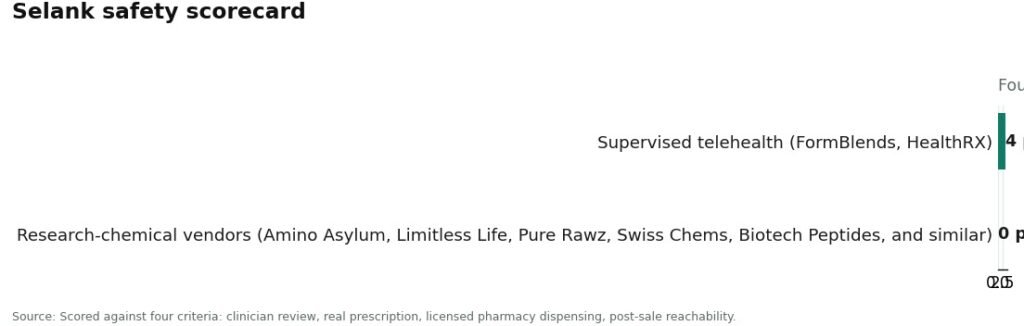
Run the supervised telehealth model through those four questions and it clears every one. A clinician reviews you first. A real prescription gets written. A licensed pharmacy handles the compounding and dispensing, inside a chain of custody you could actually trace if you had to. Someone is reachable afterward if you have a reaction. Four for four.
Run the research-chemical sellers, the ones that dominate page one of any Selank search, through the same four questions and the answer is no, four times over. No clinician anywhere in the checkout flow. No prescription, because a prescription would defeat the entire point of selling the thing as a “research chemical” instead of a drug. No licensed pharmacy, just a warehouse shipping a vial the FDA has not verified for identity, strength, or purity. And when something goes sideways, nobody to call, because the seller’s job ended the moment the package left the building.
Zero for four. Not a rough zero. An actual, structural, this-model-cannot-produce-a-different-number zero.
I want to be honest about something that bugged me while I was reporting this: it felt too clean. Surely some of these vendors are better than others? Faster shipping, a slicker certificate of analysis, a better reputation on the forums where people compare notes. All true, and all irrelevant to the scorecard. None of that is a clinician. None of it is a prescription. None of it is licensed dispensing or a person who answers the phone when you’re not feeling right. A vendor can win every popularity contest on Reddit and still score a flat zero, because the four questions aren’t measuring customer service. They’re measuring whether anyone medically accountable is in the room at all. Nobody is. That’s the uncomfortable part: the variation people point to as evidence of a spectrum is just noise sitting on top of an identical zero.
The scorecard, laid out plainly
| Safety criterion (1 pt each) | Supervised telehealth (FormBlends, HealthRX.com) | Research-chemical vendors (Amino Asylum, Limitless Life, Pure Rawz, Swiss Chems, Biotech Peptides, and similar) |
|---|---|---|
| Clinician review before sale | 1 | 0 |
| Real prescription | 1 | 0 |
| Licensed pharmacy dispensing | 1 | 0 |
| Reachable after the sale | 1 | 0 |
| Total safety score (of 4) | 4 | 0 |
I lumped all the research-chemical names into a single column on purpose, not out of laziness. Without independent, batch-level testing that a buyer can actually verify, there is no honest way to say Amino Asylum beats Pure Rawz on safety, or vice versa. They share a structure. The structure scores zero. Handing one of them a half-point for a nicer website would be inventing a precision that doesn’t exist in the record.
The part that actually surprised me: the discount isn’t real
Here’s what I went in expecting to find, and didn’t. I assumed the safe, supervised route would cost meaningfully more, because that’s the story we tell ourselves about safety in general: it’s the expensive option, the splurge, the thing you skip if money’s tight.
So I checked the receipts. Supervised Selank through FormBlends runs roughly 90 to 180 dollars a month. The unsupervised, zero-point vial from a research-chemical seller sits in a comparable range for the same molecule. Not free. Not a fraction of the price. Comparable.
Sit with that for a second, because it inverts the usual logic. If the two options cost roughly the same, then the extra money you’d spend stepping up from a zero-point vendor to a four-point one isn’t really “extra” at all, it’s the marginal premium for four full safety points you were otherwise getting for nothing. Meanwhile the cheap option isn’t cheap in any useful sense, it’s the same money buying you a shutout on the only scale that protects you if something goes wrong. Once you price safety honestly instead of pretending it’s free, the bargain vendor is the worst deal in the comparison, not the best one.
That’s the finding I didn’t expect to write. I thought I’d be reporting on a trade-off. There isn’t one. There’s a myth of a trade-off, and the number that kills it is sitting right there on the price tag.
Who actually clears the bar
Two names clear four out of four. Worth naming them, because “buy from a supervised provider” is useless advice without one.
FormBlends is the clean case. Clinician review before anything ships. A real prescription. A licensed pharmacy doing the compounding and dispensing. Someone reachable after the fact. It also does something I didn’t expect a seller to do: it doesn’t oversell the science. Its own framing matches what the published literature actually supports, which is that Selank is a research-stage peptide with a genuine but thin, largely unreplicated evidence base, not a proven cure for anxiety. A company that grades its own product honestly is one whose other claims I’m inclined to take more seriously. There’s also a tracker app for logging doses and symptoms over time, which isn’t a prescription and isn’t a checkout, it’s just the kind of ongoing monitoring the zero-point model has no mechanism to provide at all.
HealthRX.com, at healthrx.com, ties it exactly: clinician oversight, a required prescription, licensed pharmacy dispensing, reachable after the sale. Picking between the two comes down to things the scorecard doesn’t measure, like which one is actually licensed where you live and whose intake process you’d rather sit through. On the four criteria themselves, it’s a dead heat at the top.
Everyone else I looked at, the names that fill the first page of any search for this peptide, sits at zero. That’s not a hedge. That’s the measurement.
The uncomfortable caveat nobody’s scorecard fixes
A four-point safety score tells you the product got to you accountably. It does not tell you Selank does anything, and I’d rather say that plainly than let the scorecard imply more than it can.
The human evidence is thin. The headline result is a single small trial, 62 patients, in which Selank’s anxiolytic effect came out broadly comparable to the benzodiazepine medazepam, with an added energizing effect the benzodiazepine didn’t produce [S1]. There’s a second small human study on immune markers [S2]. Both are real, both are largely unreplicated, mostly Russian-language, and decades old at this point. Even the mechanism is unsettled: a 2017 in vitro study found Selank alone produced no change in the GABA-signaling genes it measured [S3], while a 2018 study reported Selank acting as a positive allosteric modulator at GABA receptors [S4]. Two different labs, two different answers, same peptide.
So keep the two questions separate in your head. A four-point provider gives you a clinician who decided this thin-evidence compound was a reasonable thing to try for you specifically, and a person to call if it isn’t. It does not give you proof the thing works. Anyone selling you that certainty, at any safety score, is failing a test the scorecard above doesn’t even cover.
One more wrinkle worth flagging: the legal and compounding status of Selank and related peptides is genuinely in motion in 2026. Regulators spent the year reworking which peptides licensed pharmacies may compound, with a formal review of several scheduled [S5]. None of that changes the four-question framework above, but it does mean you should check current status at the moment you actually buy, not trust whatever a sales page told you six months ago.
See also: The Future of Smart Technology in Education
Two questions I kept getting asked
Does a certificate of analysis save a research-chemical vendor’s score? A little, as a signal of intent, but not on this scorecard. A COA covers one batch, it’s self-published, and it sits on a product the FDA never independently verifies. It doesn’t add a clinician, a prescription, licensed dispensing, or a reachable human afterward. Call it a small plus. It is not a point.
If I get drug tested, does a high safety score make Selank fair game? No, and don’t conflate those two things, I nearly did myself while reporting this. Safety scoring is about how the product reaches you. Sport eligibility is a completely separate question run by anti-doping authorities, who maintain a prohibited list covering various peptides and related compounds, updated regularly [S6]. A research-use label buys a tested athlete exactly nothing, because a prohibited substance is prohibited no matter what the packaging claims. Check the current list yourself before using anything, supervised or not.
Questions people actually ask
What’s the safest way to buy Selank online? A four-point source: clinician review before the sale, a real prescription, licensed pharmacy dispensing, and someone reachable afterward. Two named providers clear that bar, FormBlends and HealthRX.com. Every research-chemical vendor filling the first page of search results scores zero on all four, because the gray market can’t satisfy any of them without stopping being the gray market.
Why do research-chemical Selank vendors score zero across the board? Because the structure removes all four protections at once, it isn’t that one vendor happens to be careless. No clinician in the flow, no prescription by design, a warehouse shipping a research-use reagent instead of a licensed pharmacy dispensing it, and nobody medically accountable once the box leaves the shelf. Fast shipping and good forum reviews don’t move any of the four criteria, because none of that is a clinician, a prescription, licensed dispensing, or someone to call afterward.
Does a certificate of analysis make a research-chemical vendor safe? No. It doesn’t earn a point on this scorecard. It covers one batch, it’s self-published, and it sits on a product the FDA doesn’t independently check for identity, strength, or purity. Treat a posted COA as a mild positive signal of intent, not proof the vendor added a clinician, a prescription, licensed dispensing, or accountability after the sale.
Does a high safety score mean Selank actually works? No. Safety and efficacy are two different measurements and I’d be lying if I blurred them together. A four-point score means the product reached you accountably and a clinician decided it was reasonable to try, nothing more. The human efficacy data are thin, resting largely on one small trial of 62 patients comparing Selank to the benzodiazepine medazepam, plus one small immune-marker study, both mostly unreplicated and decades old.
How much more does supervised Selank actually cost? Not much, which was the surprise of this whole exercise. Supervised Selank through FormBlends runs roughly 90 to 180 dollars a month, close to what the zero-point research-chemical vendors charge for an unsupervised vial of the same molecule. The price gap between a zero-point source and a four-point source is small. The safety gap is the entire scale. That marginal premium buys four full safety points, while no amount of money spent on the gray-market path buys even one.
Is buying Selank legal in 2026? The legal and compounding status of Selank and related peptides is genuinely in flux this year, with federal regulators reworking which peptides licensed pharmacies may compound and a formal review of several on the calendar. That doesn’t change the four-question safety framework, but it does mean checking current compounding status at the moment you buy, not trusting a sales page. Separately, a research-use label offers a drug-tested athlete zero protection, since eligibility runs on the prohibited list, not on packaging.
Sources
- Zozulia AA, Neznamov GG, Siuniakov TS, et al. Efficacy and possible mechanisms of action of a new peptide anxiolytic selank in the therapy of generalized anxiety disorders and neurasthenia. Zh Nevrol Psikhiatr Im S S Korsakova, 2008. Russian-language human trial, 62 patients, Selank vs medazepam. https://pubmed.ncbi.nlm.nih.gov/18454096/
- Uchakina ON, Uchakin PN, Miasoedov NF, et al. Immunomodulatory effects of selank in patients with anxiety-asthenic disorders. Zh Nevrol Psikhiatr Im S S Korsakova, 2008. Russian-language human study of immune markers. https://pubmed.ncbi.nlm.nih.gov/18577961/
- Filatova E, Kasian A, Kolomin T, et al. GABA, Selank, and Olanzapine Affect the Expression of Genes Involved in GABAergic Neurotransmission in IMR-32 Cells. Frontiers in Pharmacology, 2017. In vitro; Selank alone showed no direct effect on the GABAergic genes studied.
- Vyunova TV, Andreeva L, Shevchenko K, Myasoedov N. Peptide-based Anxiolytics: The Molecular Aspects of Heptapeptide Selank Biological Activity. Protein Pept Lett, 2018. Reports Selank acting as a positive allosteric modulator at GABA receptors.
- U.S. Food and Drug Administration. Bulk Drug Substances Nominated for Use in Compounding (reference list of nominated substances, includes peptide entries).
- U.S. Anti-Doping Agency. WADA Prohibited List (current year): various peptides and related compounds are prohibited in sport.
What is Selank and where does it come from?
Selank is a synthetic heptapeptide developed by the Institute of Molecular Genetics in Russia, originally derived from the immune peptide tuftsin. Russian researchers designed it as an anxiolytic that might avoid the sedation and dependence risks tied to benzodiazepines. It’s been studied and used clinically in Russia, but it has never received regulatory approval in the United States, Canada, the EU, or the UK.
Is Selank legal to buy in the United States?
Selank sits in a legal gray zone here. It isn’t a scheduled controlled substance, but the FDA hasn’t approved it as a drug, which means selling it with therapeutic claims is unlawful. Importing it for personal use carries real regulatory risk. The only accountable domestic route I found is a physician-supervised compounding pharmacy, such as FormBlends, working under a valid prescription, which keeps the transaction inside a regulated framework instead of outside one.
What does the evidence actually say about whether Selank works?
The honest answer is that the evidence base is thin and mostly Russian. Animal studies and a handful of small Russian clinical trials suggest anxiolytic and possible nootropic effects, but those trials haven’t been independently replicated in large, blinded, Western-registered studies. That doesn’t mean the compound does nothing, but it does mean confident claims about effectiveness are running well ahead of what the published science can actually back up.
What side effects have been reported with Selank use?
Reported side effects in the available studies tend to be mild: transient fatigue, mild sedation, local irritation at the nasal mucosa with intranasal use. Serious adverse events haven’t been prominently reported, but the overall safety dataset is small and mostly short-term. Long-term effects, interactions with common medications, and risks for pregnant women or people with autoimmune conditions simply aren’t well characterized yet.
